
Debate all you want on whether or not the roaches slayed their month-long assignment; you cannot deny, thanks to them, the Indian Parliament’s got a brand new aura! If you’re keeping up with the sessions, you’d know we’re not talking about some architectural renovation here. It’s the parliamentarians who’ve taken it upon themselves to go through some major glow-up — and it’s kinda giving main character energy!
Gone are the days when Tharoor-esque jargon delivered the theatrical flair on the floor. In the post-CJP era, the Parliament is ready for a full-fledged GRWM routine — except the “M” has to be replaced by a “Z”. After all, it’s Gen Z that’s got the entire country, including serious and seasoned politicians, locked in with its dank vocabulary!
Gen Z mic testing: Hold your tea
Go back a couple of months: even then, it was quite common and somewhat customary to call Gen Z the unserious generation. Boomers branded them lazy. Gen Xers thought they were too delulu for their own good. As for millennials, we occasionally stared at their rizz, in between hustle and deadlines, with equal parts envy and exhaustion.
Take us all, along with our skepticism and anxieties; even then, it wasn’t on anyone’s 2026 bingo card to watch the kids rub off on the adults so thoroughly that the "honorable” Members of Parliament would end up casually throwing phrases like "delulu," "clocked it," or, wait for it… "waste-guna-huiya" — during a session!
The Monsoon Session of Parliament rolled in; the MPs passed the vibe check and how!
Gen Z’s Parliament takeover
Ask anyone who’s followed parliamentary sessions over the years; they’d confirm. As proceedings begin, we’re usually armed with a pen and a notebook, ready for the MPs to unpack the same old familiar set of political vocabulary: democracy, the opposition, privilege motion, point of order, adjournment, and so on. On particularly productive days, “Honorable Member, please sit down” gets added to the list. Then come the usual drama, along with special nicknames: “Pappu,” “Chowkidar,” and more of these.
Sure, satire has always been part of political language. Indian Parliament is no exception. But
"Waste-guna-huiya" (or, "vasteguna huiya") making it to the parliamentary vocabulary was a bit beyond anyone’s imagination; let alone someone drawing cheers and claps for using it aptly.
ICYMI, let me recap: during a recent Lok Sabha debate on the Public Examinations (Prevention of Unfair Means) Amendment Bill, Congress MP Deepender Singh Hooda casually dropped the phrase while speaking about the legislation.
What exactly does "vasteguna huiya" mean?
Perhaps Hooda himself couldn't explain it with complete confidence.
But was it a mic-drop moment?
As Gen Z would say: “It ate bro — no crumbs left!”
And that was only the beginning.
BJP MP Bansuri Swaraj claimed her Gen Z vocab-knowledge, declaring that Prime Minister Narendra Modi had "clocked" the problem. Tejasvi Surya showed off his expertise in using internet slang as he accused the opposition of being "delulu." Shiv Sena MP Shrikant Shinde hit a home run when he summarised the opposition's conduct as a journey from “MIA” to “FOMO” to delusion.
Hooda, meanwhile, wasn't about to finish "mid." After "vasteguna huiya," he reached for another crowd-puller, recalling one of the viral and iconic placards from Jantar Mantar: "Kuchu puchu istifa dedo, aaj humara janamdin hai."
For those missing all the recent internet chatter, these might read/sound like complete brainrot. But for those who’ve been chronically online, their vocabulary is already updated.
Yes, hearing those from those politician uncles (this ain’t agism, IYKYK) hit different, but what’s really interesting about this Parliament episode is how fast and far Gen Z’s unserious lingo has managed to travel.
Any of these MPs paid a visit to Jantar Mantar during the CJP protest?
Nope.
But the protesters’ words reached Parliament.
The posters made by the students made it to the ‘gram — these uncles just digitally (and diligently) clocked it.
‘Kya bolti Parliament’?
Public language finding its way to political discourse isn’t a new phenomenon. For generations, wit and satire have helped people speak truth to power.
Political cartoons and caricatures picked humorous exaggeration as their weapon of choice. Protest poetries and songs captured the rhythm and passion of slogans. Street theatre banked on performance and harnessed the energy of spectacle to fuel mass consciousness.
Every generation found its own language of dissent.
Think about it: a few years ago, the political lexicon revolved around terms like "andolanjeevi," "urban Naxal," "toolkit," "tukde tukde gang," and whatnot. Endless arguments, counterarguments, and even campaigns erupted between the ruling party and the opposition over whether someone was a "chowkidar" or a "chor." Hashtags and WhatsApp forwards helped shape political and electoral narratives.
These weren't merely catchy phrases meant only to seek attention. They framed public debate, brought complex political disagreements to the public domain for discussion and dissection, and often, they even decided who belonged on which side of the ideological divide.
This season, a new generation entered the chat.
Gen Z chose memes, edits, and viral monologues that made sense to them. They used screenshots, GIF grabs, and even remixed slogans to speak their mind. Their choice of words wasn’t souvenirs from political war rooms or television studios. Instead, they traveled through Instagram reels, comment sections, sassy rants, or just clever punchlines. They didn’t care if others could fathom their “absurd jokes.”
But those memes traveled faster than manifestos, and “serious people” took note. After all, how long could they ignore a generation that had turned absurdist humour into a formidable political weapon?
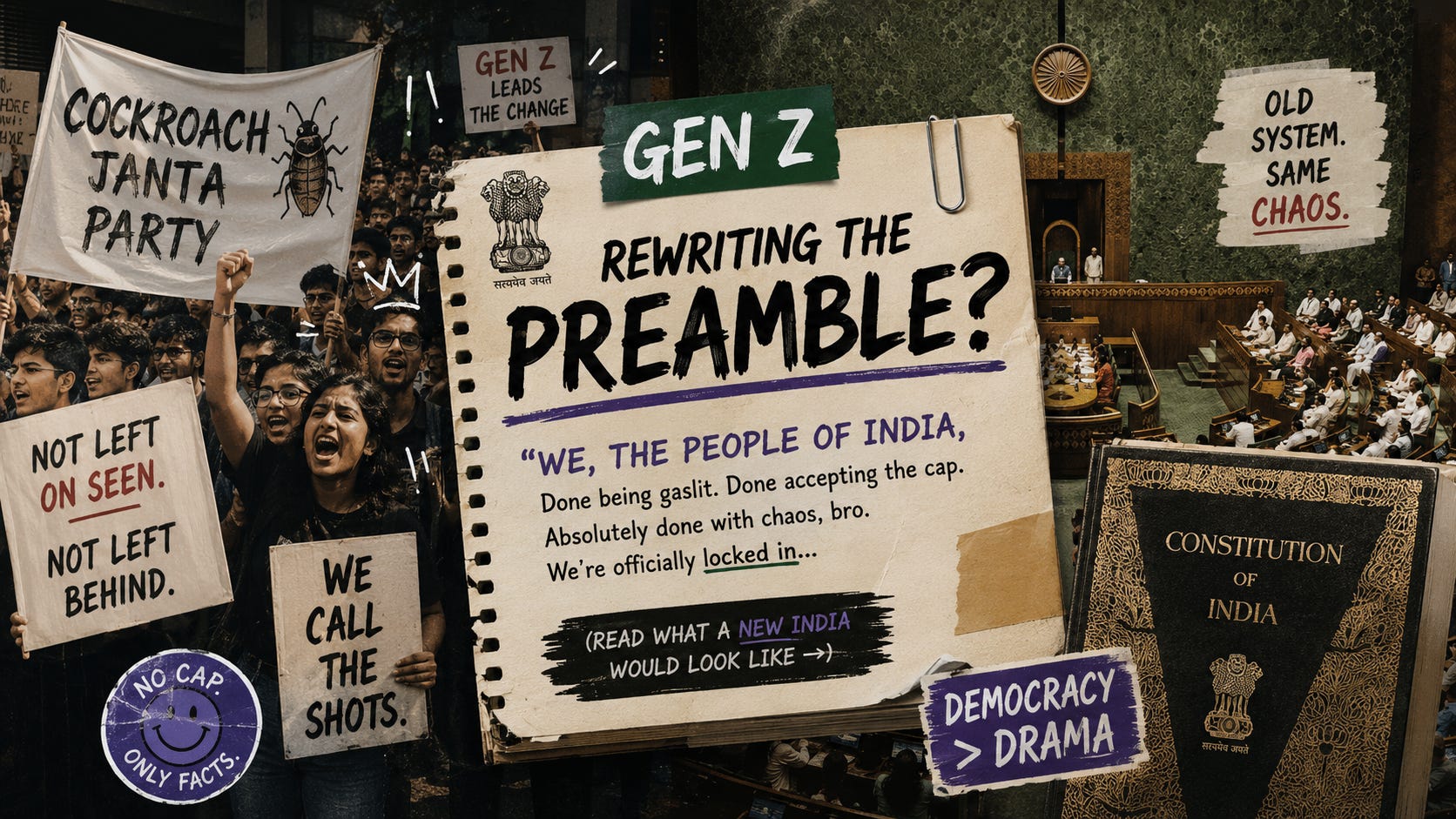
And now that this “too weird” and “too woke” generation has Parliament’s attention and the nation’s affection, would it be too preposterous to imagine a scenario where they could rewrite the Constitution as well — in their own language?
Given that they’ve often been accused of having too short an attention span to finish an entire book at one go, the Preamble would be a good start.
Thought experiment 101
Before we deliberate: this, in no way, is a conspiracy to twig Babasaheb’s masterpiece. At its core, a thought experiment is merely a hypothetical scenario — not a real one. And since thinking has yet to be branded anti-national or unconstitutional, let us try it out once.
“WE, THE PEOPLE OF INDIA,
Done being gaslit. Done accepting the cap. Absolutely done with chaos, bro.
We're officially locked in, and we call the shots on how to build a country that actually works for everyone — not just the people with VIP access. No gatekeeping rights based on religion, caste, or gender. No one gets left on seen/read because of language or where you're from. It’s gonna be real, lit, and not totally cooked.
Justice? Better be high-key.
Freedom? That’s non-negotiable.
Equality? Literally the bare minimum.
Fraternity? We're all on the same group chat — no rage-quitting, no one gets kicked.
We’re keeping democracy alive, calling out the cringe, protecting each other's rights instead of being salty, touching grass before picking pointless fights, and leaving the next gens with better vibes than we inherited.
Constitution: Locked in.
Democratic Republic of India: Loading.”
Doesn’t sound too bad, right?
Once again, none of this is a real-life attempt to raise Ambedkar from his grave.
But what about giving him some peace, trying to realize what he envisioned for this country?
‘Is this for real, bro?’
For decades, Indian political nomenclature has largely been decided by those in power. Labels like "urban Naxal," "toolkit," "andolanjeevi," or "tukde tukde gang" emerged from political battles before filtering into television studio debates and people’s everyday conversations.
This time, Gen Z pulled a Uno reverse!
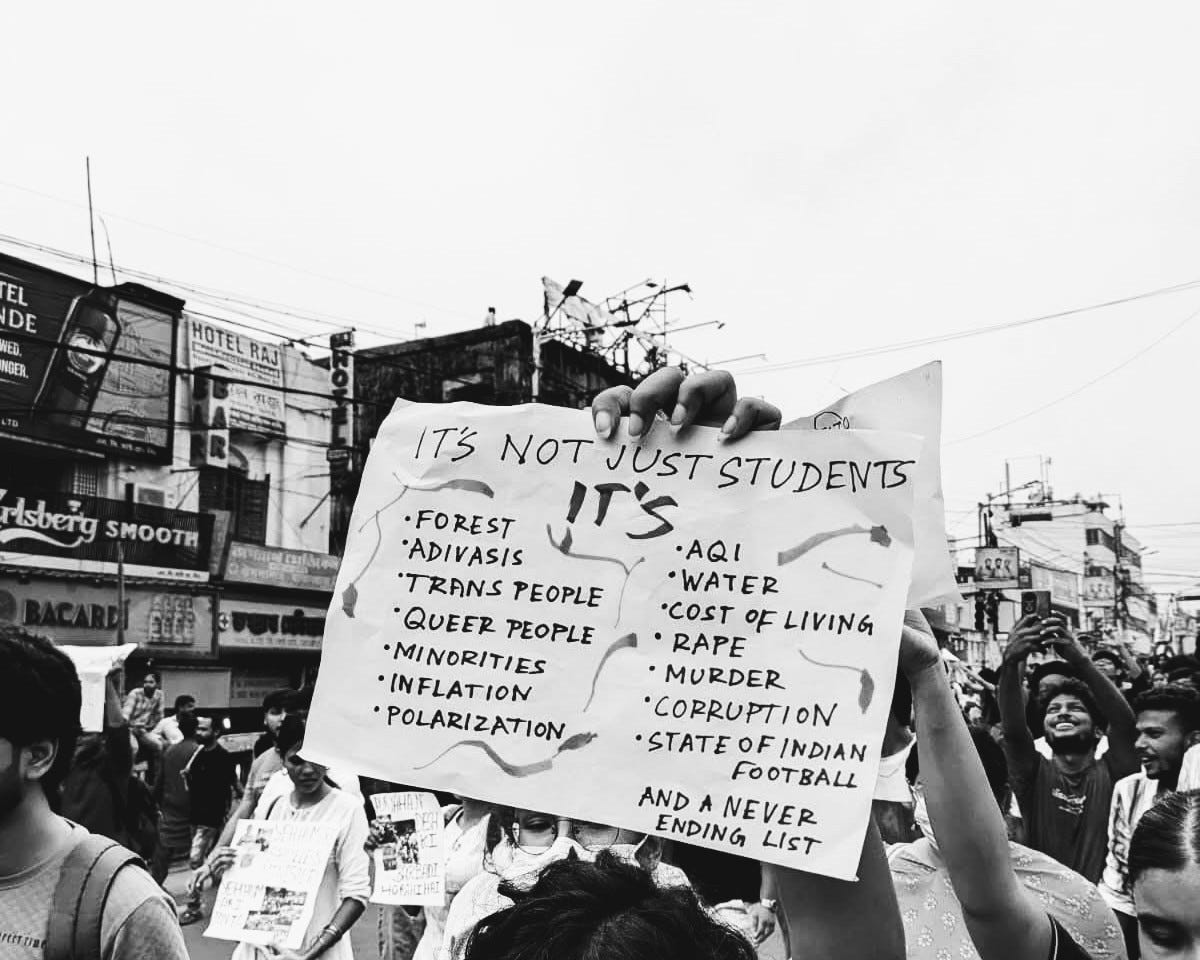
When the meme-fied generation reclaimed an insult CJI Surya Kant threw at them and made up their mind to show’em the power of parasites, many brushed them off, mistaking their stubborn conviction for yet another whim.
They showed up at the protest sites with "kuchu puchu istifa dedo," clapbacked at the police uncles with "vasteguna huiya."
Random. Absurd. Completely unserious at first glance.
But they eventually cracked the code of Mission: Impossible, and refused to leave their ground until the DP change!
Once that demand was met, some of those signs returned home with them. Others remained on the streets. Some occupied the walls until they were whitewashed. All of them, however, found a second life online. Instagram became their archive. Reels turned them into catchphrases. Screenshots carried them far beyond the protest site. Their language of dissent emerged from the internet first. Politicians followed — to the extent that the Vishwaguru was compelled to clock in to the reel culture!
That’s exactly where this thought experiment doesn’t seem too drag to be canceled.
Sure, the Constitution's enduring power lies precisely in the fact that it outlives every generation that inherits it. What changes, instead, is the language through which those generations ask that its promises be honored. But it’s not about *actually* rewriting the Constitution; it’s about putting in work to make what’s already been promised happen.
The Gen Z-coded Preamble may read like a parody, but the intent is no joke. It’s giving purpose over hollow perfection; action over just the aesthetics of greatness of a document.
It’s play-pretend; but what if Gen Z could actually clock it?
If Parliament has begun borrowing Gen Z's vocabulary, the language of dissent has already found its way into the country's highest democratic forum. What if Gen Z’s approach could really simplify the complex layers of politics to the masses, so that they became more aware of their fundamental rights and raised their voices to demand the same?
The other day, Priyanka Gandhi Vadra argued during the Lok Sabha debate that only changing camera angles would not win over the youth of India; the government would have to change the "angle" of its heart.
Perhaps, rewriting wouldn’t necessarily mean rewriting in a literary sense — but more of a realignment?
Isn’t that the underlying message?
The Preamble of the Constitution still begins with the words, "We, the People."
The CJP moment has quietly added an unwritten footnote.
We, the people, have entered the chat.
And, respectfully, the republic has been clocked.