
Been a while since India, my country, has witnessed the kind of unrest that's for the history books -- the kind that fascists either try to ban or burn. The revolution, as always, ain't televised, because prime-time slots are reserved for prime morons.
But hey, the "chronically online" generation is doing what they're "infamous" for -- documenting EVERYTHING and sharing it online. Thanks to the "wretched habit" of the "woke" generation, we're getting our daily dose of news updates that's simply vanished from the screens of the TV elites (they're busy hosting monkeys and circuses).
One has to live under Sisyphus's rock to not know what unfolded in Dilli on July 20, and how the aftermath has been spilling over ever since. Dilli Police, time and again, breaks its own record(s) of stooping to new lows, without fail; to the point where, if they were to take an exam, they'd pass with flying lathis, tear gas canisters, and whatnot.
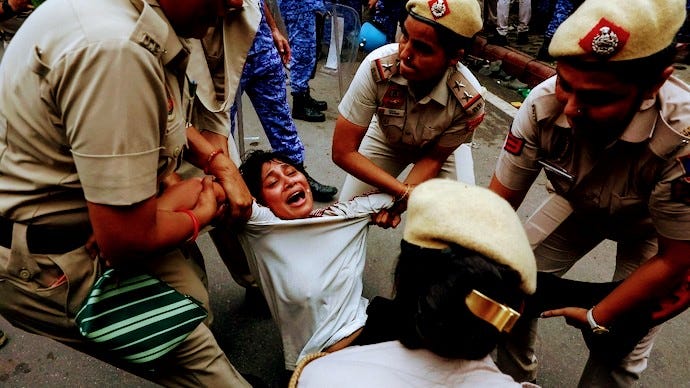
Anyhoo. July 20. In and around Jantar Mantar. In Dilli, the capital of the country. Kids. Teenagers. Twenty-somethings. Students. Parents. Partners. Cousins. Siblings. More students. Friends and folks of those who killed themselves.
Dilli Police did what they do best -- they gassed them, beat them, left them badly bruised and bloodied. One is even battling for life, reportedly in hospital, on a ventilator.
The clippings (they're really real, no AI bullshit here) that I've seen at the mercy of the algo-gods are stranger than fiction, and somehow, I'm aware enough to know that that's the real deal -- the naked picture of my country right now.
Now comes the critical (and difficult) part.
My uneasiness with Cockroach Janta Party (CJP) and subscribing to their objective isn't a new phenomenon; it's been there since day 1, and I know those differences in (political) views and opinions are gonna last -- at least till they come up with some pellet-proof ideology that can sustain in the long run of a collective (if not a party).
Do I agree with the way they started their "movement"? Their organizational approach? Their methods of calling and handling the protest march? Not really. Do I support the "headless chicken" way the Chalo Sansad march was managed? Not one bit. Did I root for the success of their endeavours despite those disagreements? Hell yes! What else is democracy if not making space for diverse arguments, with the same dream -- making our country better!
It's easy to get sentimental about this kind of protest marches, where the state opposes and the protesters progress -- defying their shield, banking on their rebellion. It's easy to get emotional about withstanding state-sponsored violence and still standing firm on our ground, because that's how we tend to define martyrdom. And that's fair. Our history shows there's glory in being a martyr for your country, for the people, for the greater cause.
What's not fair is the unevenness that state-sponsored violence comes with. This is where intersectionality comes in. Those who are the upper echelon of a movement hardly ever take the same blow as the foot soldiers face. Those who strategize don't quite bear the same cost as those who implement them do. The wider this gap of "paying the price" becomes, the more a movement loses its democratic fabric, and eventually both its essence and momentum. Unjust exploitation in the name of resilience can only go so far!
This is why it's important to be critical of leadership, instead of flattering them; instead of giving them the benefit of the doubt "just because". CJP should not be any exception to that.
First, appointing an openly transphobic and burgerholic individual as one of the spokespersons for a collective that primarily consists of the youth was vehemently wrong. What was the thought behind that decision? Where was the background check? It doesn't take an eating-while-students-are-taking-the-beating incident to recognize how problematic that individual is and finally show him the door.
Second, restricting slogans at a spontaneous mass protest and "allowing" only a handful of slogans that are safe and apolitical enough doesn't sit right either. If anything, it's sanitizing the spontaneity for the sake of populist palatability. It's basically backtracking to the same old loop of "we're not political, this isn't a political movement" dillydallying. Mind you, your "party's" bio identifies CJP as the "political front of the youth, by the youth, for the youth." And even at this point, if you're still not convinced that the atrocities the Modi/BJP government has been unleashing have been political, and for the political benefit of them all along, then the road ahead is gonna be even harder.
It comes back to accountability and transparency at the end of the day. The same things you're demanding from the government. It might seem like an ungodly hour to ask for accountability from the collective that's new on the spectrum of people's movements and has only met with the "power" of the fascist regime. But lathi doesn't negotiate; nor does it take into account how many roses they have received. Non-violence is a performance that needs an audience with conscience, and in a fascist regime, conscience is always scarce. Treading with the state that's only known barbarity, and nothing beyond that, works for the poster aesthetic. On the ground level, it's the subordinates who absorb the direct brunt of it. When the top-tier leaders give a call for such mobilization, it's their responsibility to provide the frontline people with direction as well as protection -- the bare minimum of it. When they fail to ensure that and the people closer to the flame of the fire take the hit, a mere apology doesn't cut it.
There never is a "good time" to do politics, because there never is a time when politics ceases to exist in our everyday lives. "Calmer climate" is a utopian construct that never actually arrives because ideologies are tested and tried under the tribulations of such intense periods of dissent.
Unquestioned loyalty towards leadership isn't the mark of a healthy dynamic within any collective, especially when they claim to be operating in a democratic way, without the traditional hierarchy. Surrender in the name of support, or silence in the name of solidarity -- none of these are helpful for the survival of a mass movement. If anything, cancelling critical voices only delays crucial course corrections, which are imperative for the sustenance of any long-term resistance.
That said, "mass" movements belong more to the people partaking in them than to the leadership of the collective that called upon them. The glory of a mass movement always lies with the people who build it from the ground up. That takes organizational discipline, clear objectives, substantial foresight, and the kind of humility that is open to suggestions, advice, alliances, and criticism.
A movement is more than a moment. Real and lasting change doesn't happen overnight. And for the fight to survive a fortnight, willpower isn't enough. Nor is people's power. In order for people's power to bring about systemic change that holds, that power needs to be harnessed and directed with a tried, tested, and, once again, pellet-proof strategy.
In an era of short attention spans and even shorter memories, it may be easy to forget those who came before us and showed the way. The farmers. The anti-NRC, anti-CAA protestors. Countless detained, still in jail. Democracy didn't die on July 20. It's been getting fatally shot for the last 12 years. Just because you stayed ignorant until the fire reached your gate doesn't mean that the country wasn't on fire. Now that it has, and we're finally on the same team, nothing beats taking a note or two from those who have been doing the job of firefighters, no?