
Remember the scene from Fleabag (Season 2), where Phoebe Waller-Bridge stands in a hotel washroom, wiping blood from her nose? That cheeky moment when she looks straight at the camera, and goes: “This is a love story”?
This, too, is a love story — only one dipped in piled-up disappointment, enduring a slow, aching heartbreak of witnessing the soul of that love slip away.
I want to set the record straight before I move ahead. Opening my laptop to write this on a Sunday — while recovering from the burnout of yet another hectic work week, and still reeling from the aftermath of back-to-back untoward realities my city is grappling with — has been a conflicting decision.
On one hand, I wanted to give my shoulders, my neck, and my back a bare minimum break from the relentless vicious cycle that work lately has been. On the other hand, it seemed impossible to deny the ringing impulse to sit down and write it out about what was hurting me — seeing my city collapsing in front of my eyes, bit by bit, every single day.
Those who write would agree — some wounds demand articulation, some grief refuses to wait and fade into oblivion.
Especially when the grief has a name.
My city. The city of joy. My Kolkata.
Let me dig up the fresh wound first.
The Messy Chapter, they’re calling it now.
December 13 was no ordinary date on Kolkata’s calendar this year. Then again, how banal it’d have been to think of ordinary when the city that’s been known for its devotion to football was slated to host one of the most extraordinary global icons of all time (especially, of our times)?
Lionel Messi was supposed to grace Kolkata with his presence on December 13.
So yes — December 13 was supposed to be grand, it was supposed to be spectacular and memorable, like a core memory… especially, for football fans across the city.
And it was memorable — just not in the way we would’ve hoped it to be.
The city of joy understood the assignment long back — or it seemed like it did — when the announcement was made earlier this year. For the last few months, the excitement was at its peak — so was the preparation. Imagine counting days and waiting eagerly, holding on to the “dream” of seeing the GOAT and God of football in front of their eyes!
But sadly (and shockingly), the preparation part was true only for the common people and football fanatics of Kolkata, and of Bengal — not for the organizers of the event itself, or the administration of the city.
So when the repercussions of that unpreparedness unfolded, and chaos ensued, it wasn’t a dream event anymore — it was a reality check for those who watched their hopes shattered in a packed football stadium, left vandalized and shaken to its core.
Let’s be logical for a moment here.
What would you expect when a global football icon was slated to set foot in a city that has a long and cherished history of playing, promoting, and patronizing football — not just as a sport, but as part of their inherent culture? For a city that has nurtured the likes of Nagendra Prasad Sarbadhikari, Gostha Pal, Sailen Manna, Chuni Goswami, P.K. Banerjee, and many more, hosting someone like Leo Messi should have been more like welcoming a shining star to the land of icons.
For Messi himself, it should have been more like a homecoming to another part of the world that is known to have a similar kind of fervor for football — a distant land, but familiar nevertheless in terms of affection for the sport. For him, it should have been a joyous and memorable trip to a city that came alive at the thought of the sport — whether it was partaking in a Para Football match, or watching the World Cup on a giant screen.
To put it simply, “Messi in Kolkata” should have been eventful — like the GOAT (Greatest of All Time) playing for a minute or two in the field with young footballers of the city, maybe visiting an academy to encourage youngsters, give away a few autographs, jerseys, and footballs, interacting with them, and taking pictures with them — but not fussy, or full of mess-ups.
It didn’t need grandiosity, towering statues, or excessive spectacle — it needed authenticity.
Something human. Something grounded.
Instead, irony took center stage.
Messi arrived in Kolkata on December 13, past midnight. From the airport to the hotel, followed by a meet-and-greet session with the sponsors at the hotel the next morning, was the usual course of the event. Then came the virtual unveiling of a towering 70-foot iron statue of himself — another addition to the city’s growing archive of questionable public art — alongside Shah Rukh Khan (who flew to the city just for this) at Sree Bhumi Sporting Club, Lake Town.
Now, the less we talk about the statue, the better — in a sea of seriously ugly sculptures the city is currently drowning in, this one ranks really high on the list.
After unveiling that statue in the name of illustrious abomination, Messi left (along with teammates Luis Suárez and Rodrigo De Paul) for the Vivekananda Yuva Bharati Krirangan, more commonly known as the Salt Lake Stadium, for a felicitation ceremony and fan interaction — and that’s where this disaster unfolded.
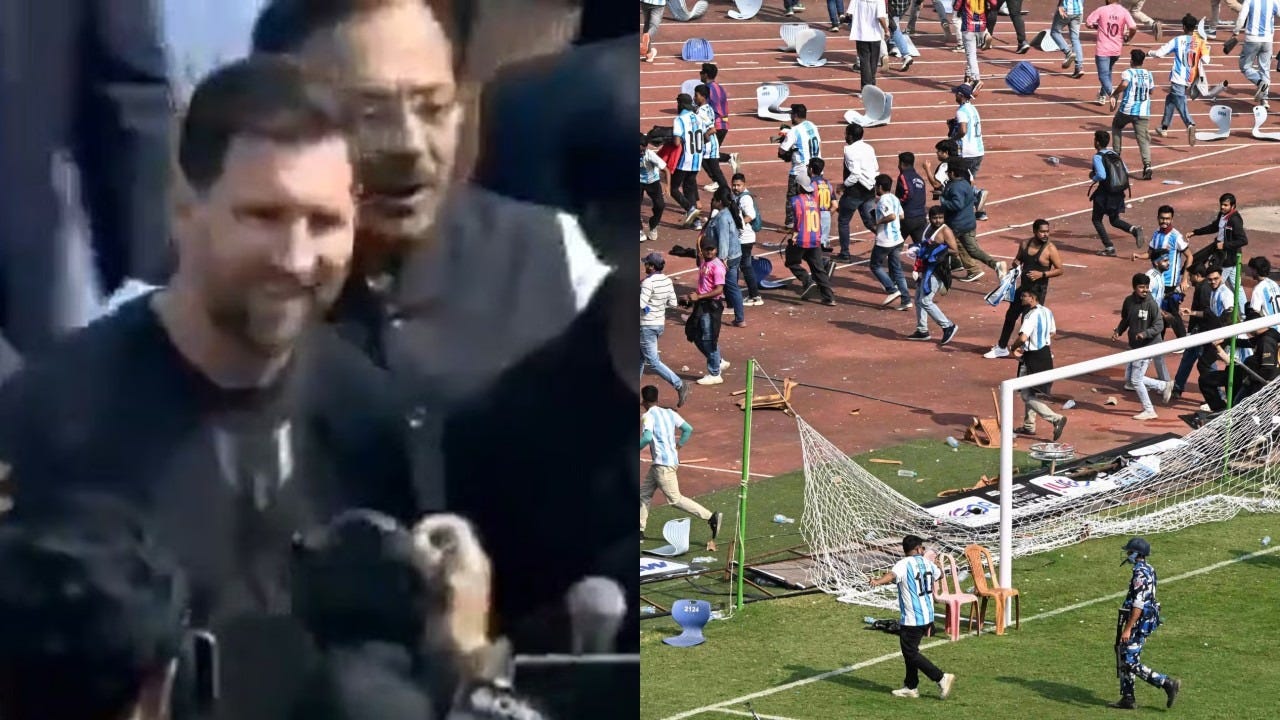
Mobbed by corrupt and greedy ministers, their outright shameful acts of using their power and privilege for unsolicited selfies, a string of photographs with their folks, and whatnot, Messi left the venue in no more than 20 odd minutes (he was scheduled to stay for at least 45 minutes) — without any fan interaction whatsoever.
What was meant to be a heartfelt one hour of expressing admiration and exchange of warm appreciation for the world’s greatest, turned into an embarrassing 20-minute episode detailing distasteful entitlement and a grotesque photo-op.
Messi left the stadium before time, and hell broke loose.
Could we have expected any other outcome?
Imagine saving money for months in prior to buy tickets for just this one event, even spending money worth a whole month’s salary just so you could catch a glimpse of the God of football in person instead of only seeing him on a TV screen, and ending up being robbed of that chance because a herd of officials, politicians, and their pack of folks could not keep their hands off him — quite literally so.
Their sense of loss was profound.
The fans hadn’t come for the VIP theatrics displayed by the ministers and officials — they had come for football, for the God of football, for a dream.
So the consequence that followed was predictable. The visibly angry and upset fans unleashed their fury on the stadium, throwing chairs, water bottles, and whatever else they could, ripping off seats, leaving the stadium vandalised… the same stadium that greeted Diego Maradona almost two decades back, roaring in joy, but still in decorum, discipline, and dignity.
The situation escalated so far that the Rapid Action Force (RAF) had to be deployed to assert control and restore order.
Talk about a historic moment!
But this shouldn’t have happened in Kolkata — in the Kolkata I grew up in.
Messi coming to Kolkata should have been historic, yes — but almost poetically so. Football, after all, has been part of this city’s bloodstream. Common people with limited financial resources did not spend thousands of bucks out of sheer impulse — they did it out of their passion, they did it because they wanted to realise a dream, a dream to see the God of football up close. And they did it because Kolkata has a longstanding history of hosting guests in the humblest yet the grandest manner.
Because, once upon a time — it seems like a lifetime ago — my city knew how to host guests, how to welcome them warmly and in thunderous joy, and still make them feel at home.
I was a mere teenager when Maradona came to the same Salt Lake Stadium, made his speech as a translator did their job standing right by him, greeted his fans, played with footballers in the field, and most of all, stood in the middle of an enthusiastic crowd that was elated in joy but didn’t leave the man feeling mobbed. The stage wasn’t overflowing with a set of power-hungry politicians hogging for attention and their parasitic sidekicks lobbying for favors, nor was there any over-the-top photo-op flooding with wannabe celebrities with zero contribution to the city’s culture and heritage, let alone any substantial representation of the city on a bigger stage.
Admiration existed without entitlement. My Kolkata understood restraint. My city knew how to show respect without turning an event into a spectacle that only transformed the city into a laughing stock.
My city held space for cultural progression, without the obnoxiously boisterous and chest-thumping proclamation of it, while contradicting the same in reality.
Yesterday, the people in the stadium didn’t “make a scene” because they were unruly — they were outraged because they were betrayed, because they were robbed of the opportunity that came in exchange for a hefty price.
What unfolded yesterday was not merely an organisational failure — it was a symptom.
VIP culture, unchecked nepotism, political interference, and absolute disregard for crowd ethics took precedence, and all the commoners were left with nothing but shattered dreams and a sharp sting of betrayal.
And yet today, when I sigh in disgust and disappointment, seeing Kolkata’s downfall, when I’m heartbroken over the global coverage of the embarrassment, what rattles me the most is how my mind goes on a repeat mode, “This was supposed to happen.” How the alter-ego keeps popping up with the same old question: “What else did you expect? Haven’t you learned this lesson already?”
And maybe refusing to learn the lesson while keeping a humongous stone on my heart has been my biggest shortcoming over the years. Refusing to accept that the glorious days of my city now lie in the distant past. That, the city that once was steeped in history, culture, grace… the city that once had its soul embedded in each corner, every dimlit lane… that city is gone with the wind — the wind of “change” (oh read it if you will: পরিবর্তন).
Think about it — because the unravelling doesn’t end just here.
The next chapter is the one where food became the fault line.
The city I grew up in was the epitome of gastronomic culture, various kinds of it. To imagine an evening adda without delicious food as the center of attention (yep, মধ্যমণি), or a Sunday without Kochuri-aloor dom–jilipi as breakfast, followed by mutton-er jhol for lunch, seemed like a blasphemy, and ending any holiday with luchi and the chichen kosha felt like an obvious ritual. To think of a casual stroll around the city, or catching up with friends, without indulging in street delicacies or phuchka seemed unrealistic. Every date was more about the food menu than any other plan. Even Pujas and all other celebrations here were sort of just another exuberant occasion to dress up and gorge on good food together!
In short, gastronomical policing wasn’t only an alien concept to us — it simply didn’t exist, in any plane or dimension whatsoever.
Cut to 2025.
A daily wage worker was forced to leave this city for earning his livelihood by selling non-vegetarian food.
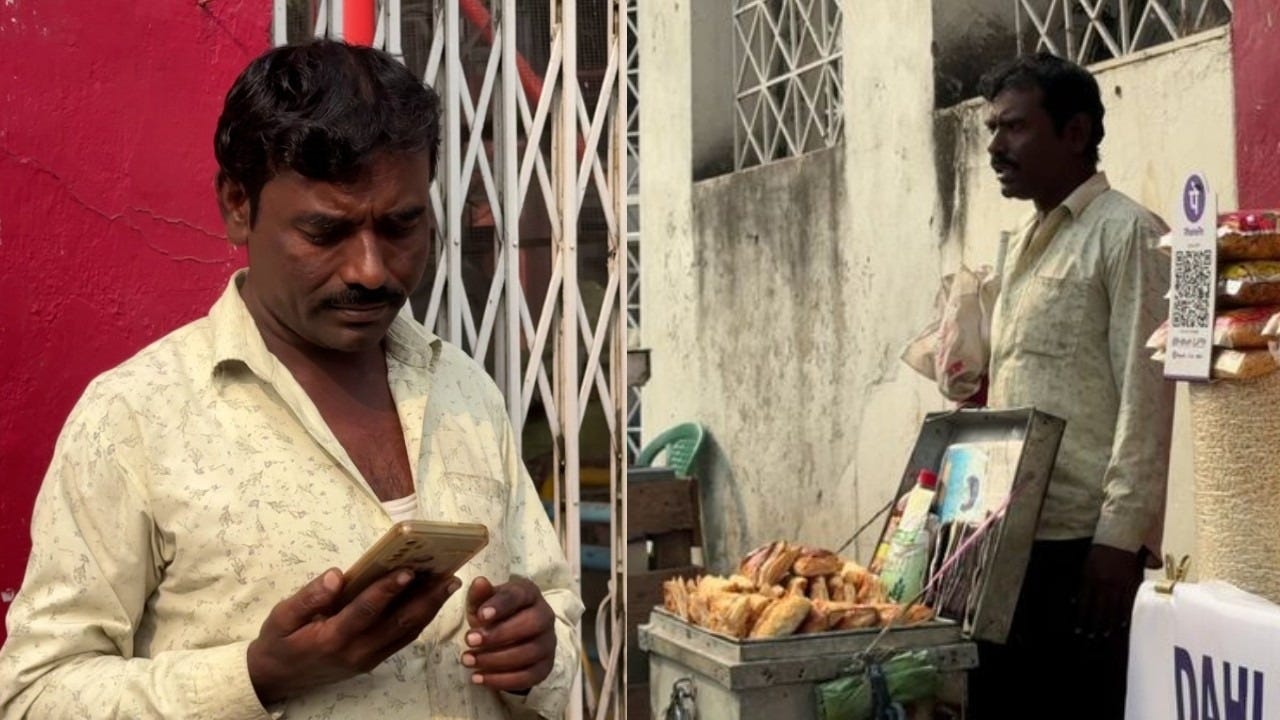
Case in point: The mass Gita recitation at the Maidan ground earlier this month, the space that’s an usual habitat of small vendors selling jhalmuri, chicken patties, small packets of various nuts with rock salt sprinkled on them, lemon tea, and more. The 50-year-old chicken-pattie vendor, who was going about his day the same way he does for the rest of the year — selling chicken patties and earning his living — was assaulted by Hindutva Hooligans.
Think of the audacity here — a worker being surrounded, slapped, and forced to perform sit-ups, literally at his usual workplace, while the assailants throw away his stock of patties worth nearly ₹3,000 or more.
Sheikh Riyajul, the chicken-pattie seller, who apparently belongs to the “religion of enemies,” wasn’t protesting or provoking anyone while the mass Gita Path was on — he was just doing his job, i.e., selling patties. In all probability, he simply hoped to sell a few more items that day, because of the mass gathering there. And for that “crime”, he was questioned about selling non-vegetarian food at a religious gathering, and was assaulted to such an extent that he decided to leave the city.
Imagine harassing someone for selling food, just based on your own religious beliefs. Imagine assaulting someone at their workplace — vendors walk around selling food all over Maidan, throughout the entire year. And imagine being so intolerant in the name of God that you end up destroying someone’s livelihood for it.
This wasn’t the norm in my city before.
The day Riyajul left Kolkata for his hometown, as per a Times of India report, he said tearfully that “the city has given me so much love, but Sunday’s incident broke my heart ... I can’t stay here any longer.”
This heartbreak… it can’t be measured. Perhaps, it can’t be put into words as well.
For someone who has always been in love with the city for being her greatest shelter through all the storms and more, seeing someone leave the same city because they felt “unwelcome” at that home — it felt deeply personal. And heartbreaking.
Imagine the grief of witnessing a city’s downfall — the city that was once known for its soul, now rapidly shrinking its space for something as bare minimum as inclusivity.
And it’s not just about one isolated incident anymore — it’s a continuous thread of exodus that’s taking place; silently, but surely.
We’re in the age of the Great Bengal Exit now.
If you look closely, you’ll realise how the fabric of the city is changing… like the soul of the city disappearing in thin air, leaving its very existence devoid of everything that made Kolkata the city of joy!
Just the way, humans of the city are leaving it behind for better exposures, opportunities, and an overall better quality of life.
In fact, it used to sound so lame when I first started saying it in my friends' circle: “Bangalore is more Kolkata than Kolkata itself is these days.” It’s still odd to hear it, given how different the cultures are in the two places. But that doesn’t refute the truth anymore — the truth that states, “The Bengal Exit” is an ongoing process, with the hopes of only getting more intense and widespread in the coming days.
Recently, Kirti Vardhan Singh, the Minister of State for External Affairs, shared the data in the Parliament that revealed how nearly nine lakh people did so in the last five years.
I can’t even bring myself to dig up the data that’ll tell me how many Bengalis have left Kolkata, this city, and this state, in the last five years, looking to build a better life. It’s not funny how scary and vivid that sadness is.
Sure, I can rant about it for hours — even to those friends. I can be silly, I can whine as well.
But can I blame them, rationally, for choosing something better for their well-being?
Hardly so.
What do we have left in the city anyway?
A broken educational system, where the teachers are found on the streets — heckled, threatened, malhandled, pinned to the ground — instead of classrooms. A healthcare system with nothing but corruption running through its veins, leading to the infrastructure of government hospitals falling apart, while the corporations count millions through private facilities, exploiting common people. The public transport system is in shambles, leaving people with little to no other option but to spend on pricey app cabs or resort to investing in private vehicles.
What makes all of these seem more difficult in terms of affordability and accessibility? The absolute death of jobs that pay fairly well to help keep up with such an increasingly expensive lifestyle. Not to mention the lack of ethics, dignity, and fair play in workplaces that we’re left with.
And then there are instances like the RG Kar rape and murder incident — where a 31-year-old lady doctor was raped and murdered on duty — which not only marked us unsafe at our workplaces, especially at a workplace like a hospital, but raised the concern of a bigger and deeper institutional conspiracy that might have enabled and paved the path for such an incredibly horrific incident.
Once upon a time, Bengal stood at the forefront of progress.
Talk about cultural heritage, intellectual richness, political sharpness, social activism, or even economic stability — Bengal, as well as Kolkata, used to be the capital that others envied. Sure, we’ve often been tagged as lazy, nostalgic, snobbish, and have even been hallmarked for sometimes being on our so-called high-horses.
But I swear, our vanity didn’t strip away our mindfulness.
Yes, we rooted for a slow-paced living, we often preferred looking back at our heritage like cherished heirlooms, we took pride in the same, but at the end of it all — we worked hard to carry that invaluable legacy ahead.
Yes, we prioritized “lyadh,” we considered “torko” (debate) sacred and took it too seriously, and our afternoon power naps made it to the important list of to-dos — but never did we waver from putting in the effort to get things done.
And most of all, we knew how to embrace — how to include someone, to welcome them with arms wide open, and to make them feel at home, without causing them trouble. My Kolkata welcomed differences — be it for people with different food habits, different religions, from different occupations, or just different strata of society at large.
We didn’t fall short when it came to standing up and speaking for the right cause, taking to the streets to protest against anything and everything unjust — demanding equality and justice. My city knew how to make space, for all.
Today, my beloved city seems like a playground for morally corrupt politicians in the administration who would go to any lengths to serve their own agenda, even if that meant humiliating the city (the state and the country in extension) in front of the whole world — because what else would fill their cups more than looting common people of their means, money, and faith in the name of “উন্নয়ন” and “খেলা হবে”!
In today’s Kolkata, power matters more than its people.
The city I grew up in exhibited excellence in every aspect, in every sphere possible — be it filmmaking, storytelling, creating a safe space for artists, thinkers, and writers, nurturing the activists, the revolutionaries — all the while conducting itself with unmatched composure, grace, and dignity. My Kolkata could do it all without making too much of a fuss about it. And that was the enigma — her aura!
That era is gone. So is the glory.
What remains is this anarchy, social and political debauchery, and a thick layer of smog that’s choking us to a gradual but inevitable demise.
What a cruel irony it is that even the AQI of Kolkata these days resembles the decay of a city whose soul is getting sucked away!
And yet, like all love stories, this one hurts the most — not because it ended, but because it’s still alive, counting its final breaths in front of us.